Fintech
Mobile
Payments
UX
Storipago
Payment Experience 💳
A systematic, native mobile payment framework designed for small business owners—leveraging reusable tokens and patterns to deliver a secure, frictionless transactional experience for merchants.
ROLE
Product Designer
PLATFORM
Native Mobile (iOS & Android)
INDUSTRY
Fintech
TOOLS
Figma · Maze
⚠️
Project context
This initiative was paused due to shifting business priorities before reaching production. The work shown reflects the design exploration and early validation phase — which played a key role in defining the product direction.
View in Figma 🡥
✦ OVERVIEW
Payments should be
simple for everyone.
Storipago was a product initiative at Stori to help small business owners accept card payments directly through the app — no POS terminal expertise required.
The challenge: our users had low financial literacy and no prior experience with digital payment tools. Every design decision had to prioritize clarity, confidence, and speed above everything else.
✦ PROBLEM
Accepting cash only
has an invisible cost.
Stori users who owned small businesses already trusted their Stori card for personal finances. The real problem was on the other side: when it came to collecting payments from their own customers, cash was their only option — limiting their sales and growth without them realizing it.
🏪
No way to accept card payments
Their customers wanted to pay by card, but there was no way to receive them. Every "I don't have cash" was a lost sale.
📉
Total dependence on cash
Operating cash-only meant security risks, no clear transaction records, and a real barrier to growing the business.
🔗
No solution within the Stori ecosystem
They already trusted Stori for their personal finances — but the product offered nothing on the income side, only spending.
📱
External solutions were too complex or expensive
Market alternatives required paperwork, costly hardware, or technical knowledge that put small business owners at a disadvantage.
✦ APPROACH
Mobile-first, clarity-first,
always.
I focused on reducing every step to its essential action — if it wasn't necessary for the user to complete the task, it didn't exist. Flows were tested with real users early, and iterated before moving to high fidelity.
01 — Research
User interviews 🎙️
Talked to small business owners in the Stori user base to understand their current payment habits and barriers to going digital.
02 — Flows
Critical paths 🗺️
Mapped the three key flows: business onboarding, terminal activation, and payment collection — and identified where users dropped off in testing.
03 — Design
Guided experience ✦
Designed step-by-step flows with contextual instructions, clear permissions, and real-time feedback — reducing cognitive load at every point.
04 — Validation
Usability testing 🔬
Ran moderated sessions with target users to validate comprehension and completion rates before moving to development handoff.
01 — BUSINESS ONBOARDING
Start accepting payments
in minutes, not hours.
Simplified the business registration flow with clear value propositions at each step and minimal required input — reducing drop-off and getting users to their first payment as fast as possible.


02 — DEVICE ACTIVATION
Terminal setup that
doesn't need a manual.
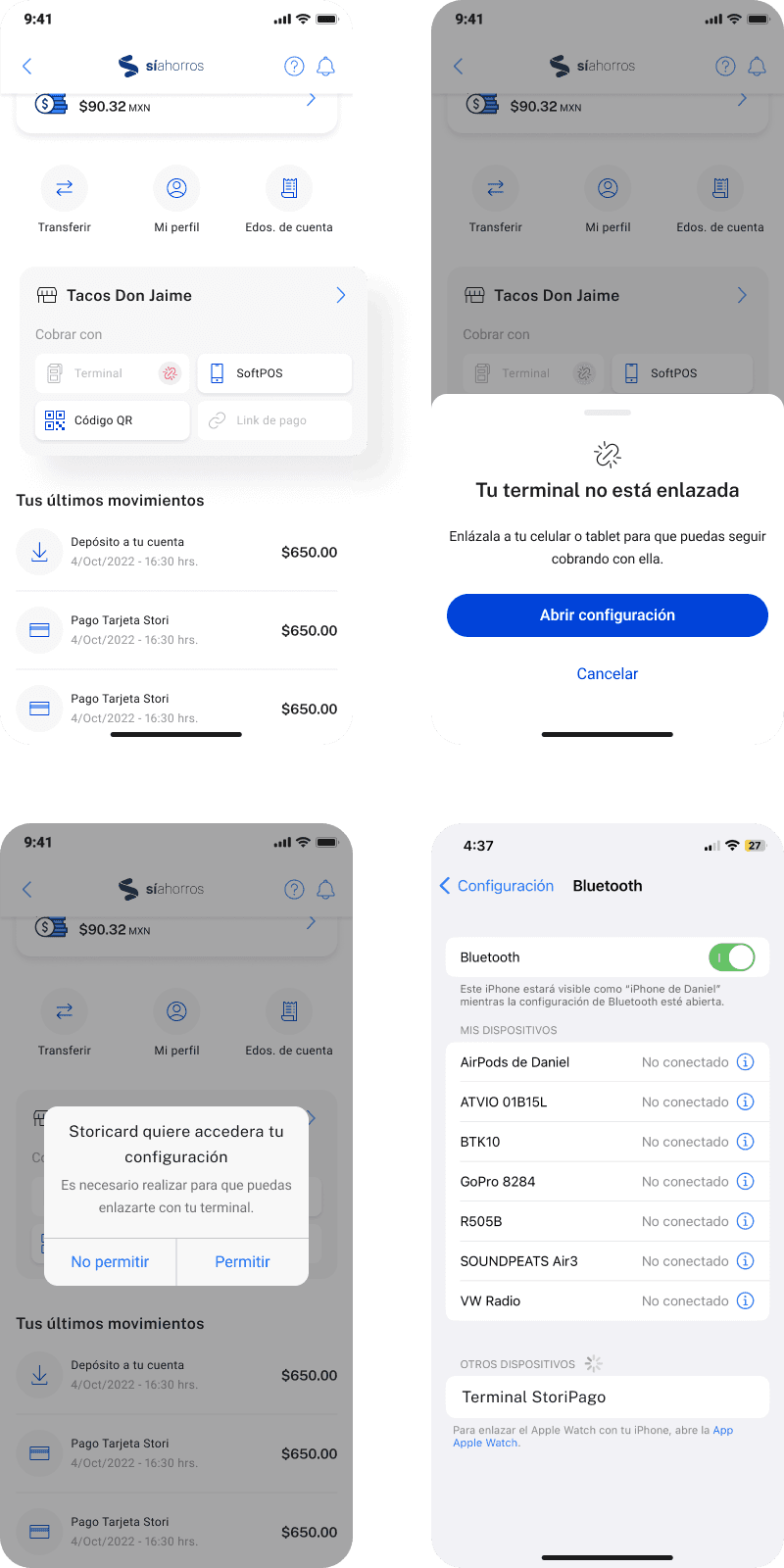
Designed a guided, step-by-step activation flow for pairing the card reader — with contextual system permission requests, real-time connection feedback, and clear error recovery states.

03 — TRANSACTION FLOW
Every payment feels
safe and confirmed.
Built the end-to-end payment experience with native iOS patterns, real-time status updates, and clear success/error states — reinforcing trust at the most critical moment of the flow.

